
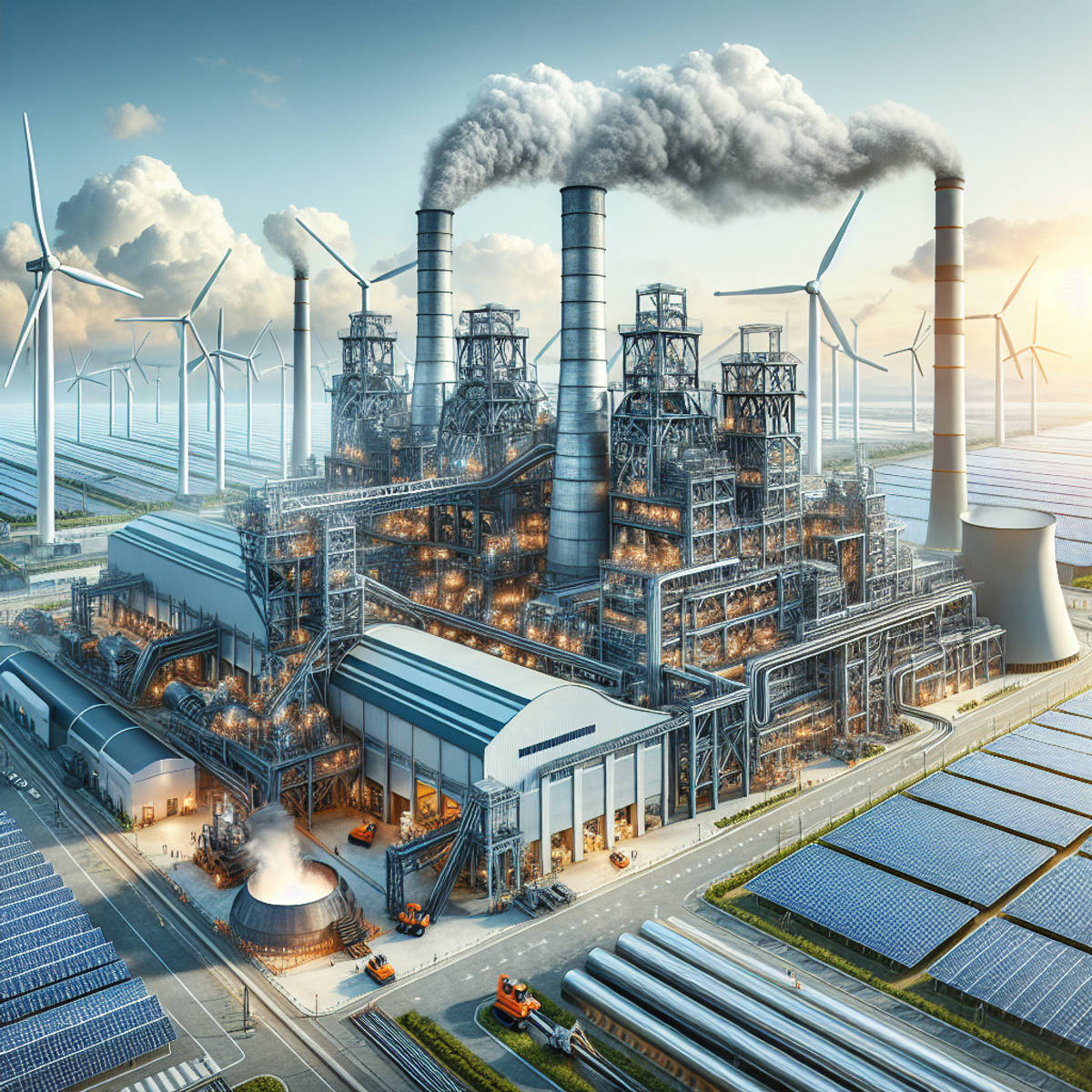
Hey there! Have you ever thought about how the steel in our cars, buildings, and appliances is made? It’s a process that’s been around for centuries, but it’s also one of the biggest contributors to global carbon emissions. Let’s dive into how the industry is evolving to become cleaner and more sustainable.
The Traditional Steelmaking Process
Traditionally, steel is produced using blast furnaces that rely on coal and coke to extract iron from ore. This method is energy-intensive and emits a significant amount of carbon dioxide. In fact, steel production accounts for about 8% of global carbon emissions. That’s a hefty footprint for a material we use so extensively.
Enter Cleaner Ironmaking Technologies
The good news is that innovative technologies are emerging to tackle this issue. One promising approach is Direct Reduced Iron (DRI). Instead of using coal, DRI utilizes natural gas or even green hydrogen to reduce iron ore. This method can slash carbon emissions by up to 50% compared to traditional blast furnaces. And if green hydrogen is used, the process can be nearly carbon-free.
Spotlight on Electra
A company making waves in this space is Electra. Based in Boulder, Colorado, Electra has developed an electrochemical process that refines iron ore into pure iron at just 60°C (140°F), using renewable electricity. This low-temperature method not only reduces emissions but also allows the use of lower-grade iron ores, which are more abundant. Electra recently secured about $8 million in tax credits to support the construction of its new demonstration facility in Jefferson County. (axios.com)
Boston Metal’s Molten Oxide Electrolysis
Another player to watch is Boston Metal. They’ve developed a process called molten oxide electrolysis (MOE), which uses electricity to convert iron ore into steel without emitting carbon dioxide. This technology has attracted significant investment, including $120 million from ArcelorMittal, the world’s second-largest steelmaker. (apnews.com)
The Role of Policy and Investment
Government initiatives are also playing a crucial role. The U.S. Department of Energy announced up to $35 million in funding to support programs aimed at developing zero-emission ironmaking and ultra-low emission steelmaking. (arpa-e.energy.gov) Additionally, the Biden administration allocated $6 billion to decarbonize the U.S. industrial sector, with a focus on industries like steel and aluminum. (apnews.com)
Looking Ahead
While these technologies are promising, scaling them up to meet global steel demand is a challenge. However, with continued investment, innovation, and supportive policies, the future of steel looks greener. As consumers, being aware of these advancements can help us make more informed choices and support industries that are striving for sustainability.
So, next time you see a steel structure or drive your car, remember that there’s a revolution happening behind the scenes to make that steel cleaner and better for our planet.



Leave a Reply